Monday, March 16, 2009

Hungarian Beigli - Celebration Cake

Beigli are the traditional Hungarian walnut or poppy seed roulades seen at Christmas time, Easter and for wedding celebrations. They have a firm tender crust, a crackled exterior and a moist filling. Extra fruit is added to the filling to give it extra moistness.

In his wonderful book - Kaffeehaus: Exquisite Desserts from the Classic Cafés of Vienna, Budapest, and Prague - Rick Rodgers explains how the rising of the dough is carefully modulated with refrigeration to get a nice tight crumb. In the old days it would have been snowing outside and finding a nice warm place would have been harder than it is today.


I learnt to make Beigli from my Hungarian mother-in-law (Nagymama - or grandma in English) who is now 84. Nagymama didn’t have the luxury of a KitchenAid or mixer and painstakingly made 32 rolls each year.


I have taken it upon myself to bake them for the family, even though I am from an Anglo-Saxo Australian background of four generations. It has become part of my children’s heritage that they love very much. Of all my extended Hungarian family of over 50 members, only my son and one nephew have also learned to make Beigli. I am very proud of Andy and Tom for this as it is no light undertaking (even more experienced bakers suffer anxiety in front of their ovens each year - will the pastry crack, will it crumble when cut?). For this reason, if I make them for the other family members, I won’t let them have them before Christmas as they get eaten before the big day. Andy has been known to eat two whole rolls in a day before Christmas Day.


The walnut is most popular, but poppy seed lovers swear by there choice. My photo doesn't do teh beigli justice. Beigli are usually set out in alternating poppy seed and walnut layers. You need both to display nicely on the platter.


The measurements for this recipe are a little odd as Nagymama gave them to me originally as decagrams which I have adapted.


This recipe makes 4 rolls


Ingredients for the dough:


560gm plain flour

210g butter

60g icing sugar

10g fresh yeast

200ml milk (room temperature)

pinch salt

beaten egg yolk to glaze.


Mix the milk and yeast in a small bowl and leave to froth for 10 minutes. Blend butter, flour, salt and sugar then add the yeast mixture. Mix until the dough is smooth and leaves the side of bowl clean. Divide the dough into 4 pieces and let it rest for half an hour.


Roll out each piece into a 12 x 14 inch (30 x 35cm) rectangle.

Spread each piece with filling leaving a 1/2 inch (1.5 cm) border all around and roll up tightly lengthwise, pinching seems closed. Transfer, seam side down, to a baking dish with 5cm (2 inches) between rolls. Brush with the beaten egg yolk. Leave overnight in the refrigerator. Brush with egg yolk again. Let stand for egg to set then poke holes with a skewer. This is to let the steam escape while the beigli are cooking and help prevent splitting


Bake in a moderate oven 180C 30 – 45 mins or until brown. Don’t open the oven until after 20 minutes.


Make walnut beigli first as the poppy seed will make the walnut look dirty if used first.

Walnut mixture (enough for 2 rolls)


250g walnuts

1/2 cup plain sweet biscuit crumbs (or cake crumbs or bread crumbs)

250g pure icing sugar

50g raisins

1 Tbs apricot jam

100 ml milk


Put the milk in a pan with the sugar and bring to the boil. Add other ingredients. Let cool.


Poppyseed mixture (enough for 2 rolls)


250g poppyseed

1/2 cup plain sweet biscuit crumbs (or cake crumbs or bread crumbs)

250g sugar

1 Tbs apricot jam

50g raisins

100 ml milk


Put milk in a pan with sugar and bring to the boil. Add poppy seeds and raisins. Simmer for a few minutes, stirring constantly. Then stir in other ingredients. Let cool.


The beigli can be stored once cooled. Don’t cut the logs until you are ready to serve them. To serve, arrange the slices on a plate slightly overlapping like roof tiles, alternating poppy seed and walnut. The rolls can be kept for up to a week wrapped in aluminum foil and stored in an airtight tin.


Saturday, March 14, 2009

World's Longest Lunch 2009 - Crown Riverside, Melbourne


It's Miss Patricia's birthday (not saying which one - but it was the Big One) and we have taken her to the World's Longest Lunch 2009 at Crown Riverside - A celebration of Italian inspired cuisine - Melbourne Food and Wine Festival Presented by The Age.

On arrival we are handed a bottle S. Pelligrino and of a glass of Opheilia Sparkling. On each seat was a recyclable shopping bag from 'The Age' filled with goodies and brochures. To nibble on, there were large jars of olives, pickled peppers, and bowls of artichokes, stuffed peppers and marinated boccocini cheese with little tomatoes.

Can you spot Miss Patricia!!

Entree - an antipasto plate with proscuitto, salami, baked roma tomatoes, char-grilled vegetables, asparagus, marsala melons and shaved parmesan.

Main course - Grilled beef tenderloin with Tuscan herb crust on field mushroom and almond broccolini with cannellini bean salad.

Dessert - Zuppa Inglese with Alkermes Liqueur, candied fruit, glazed cherries and amaretto biscuit.


Beverages -
Ophelia Sparkling
Juliet Sauvignon Blanc, Chenin Blanc
Juliet Pinot Noir
Juliet Moscato
James Boag's Premium
S.Pellegrino, Acqua Panna and Sparkling Fruit Beverages
Coffex Coffee

A Sydney foodie and fellow blogger down for the day.

Musical Chefs - They don't only cook for us.

And the wine kept coming!

Italian Music while we dine.

'J' spots Jill Dupleix

What a great day for all!


Monday, March 2, 2009

Fig, Star Anise and Rosewater Jam

I've have just made Jackie Middleton's (Prahran Market's Harvest - best of the season) Fig, star anise and rosewater jam . It is divine and so quick and easy. I will be making other goodies soon to go with it which I will post.

(Jackie Middleton has asked us all to please suppport Handmade Help. They are looking for contributions to a cook book that they are putting together in aid of the Red Cross Bushfire Appeal)

Fig, star anise and rosewater jam

500g figs, rough chopped no larger than a 10c piece
500g CSR jam setter sugar (already has apple pectin and citric acid in it)
1 star anise pod
2 bay leaves
4 drops rosewater.

Cook the figs with the star anise and bay leaves gently, until the figs just start to soften and break down, stir constantly.
Add the jam sugar and cook stirring for 4 minutes.
Remove from the heat and test the setting stage.
If it is set, remove bay leaves, add the rosewater, mix well and store in sterilised jars.


Sunday, March 1, 2009

Orange Sour Cream Poppy Seed Grand Marnier Cake


This is an absolutely lovely moist cake. It looks fantastic & tastes even better. I usually make this recipe as a large cake using a kugelhopf tin (8 cup/2 litre). You could also use a fluted ring tin.


I also love the idea of having individual little cakes for everyone to enjoy. It makes one feel as if it is a treat especially for you.


Large or small?


I found the Baker's Secret 12 cup mini bundt pan with the same shapes as a kugelhopf tin and fell in love with it. I had to add it to the cake tin collection of which there are already too many. As my dear friend Pat was having a party for her Big One and as we have both made this cake for ever so long, I thought having baby cakes would be a nice twist on an old favourite. The original recipe came from an old Australian Vogue Magazine from the 1980's.


Baker's Delight kugelhopf tin and mini bundt tins


I have made it recently for my daughter but I used 200g of poppy seeds (as stated in the original recipe) which made it a bit heavy, so I have gone back to using 100gm.

Orange Sour Cream Poppy Seed Grand Marnier Cake

Ingredients:

250g unsalted butter
200g caster sugar
3 egg yolks, beaten
200g sour cream (not light)
*grated rind of 1 orange (see note below)
1 3/4 cups (265g/8 1/2 oz) self-raising flour
100 - 200g poppy seeds
3 egg whites
pinch of salt

Syrup:
3/4 cup castor sugar
juice and zest from 2 oranges and 2 lemons
3 tablespoons Grand Marnier (or Contreau)
pinch of salt

Preheat the oven to 160°C. Butter and flour the tin.

In a small saucepan, melt the butter then cool it. Combine the sugar, egg yolks, sour cream and grated orange rind in the mixer bowl. Add the melted butter and beat until light and fluffy. Stir in the sifted flour and poppy seeds (rather than sifting the flour, a quick alternative is to use a whisk to aerate the flour).

In a separate bowl, beat the egg whites until they hold firm, but not dry peaks. Whisk in 2 tablespoons of this meringue to wet the mixture then gently fold in the rest into the mixture until it is just incorporated.

For the mini bundt tins, use a piping bag to pipe the mixture evenly into the molds, filling them 3/4 full (or turn the mixture into the kugelhopf tin if making a larger cake) . Bake the mini bundt cakes for 20 minutes (1 hour for a larger tin) or until a skewer inserted in to the centre comes out clean. Stand for 10 minutes before turning out.

Syrup:
Combine the orange and lemon juice, Grand Marnier, sugar, salt and zest in a small saucepan. Heat stirring until the sugar is dissolved. Bring to the boil without stirring , then reduce the heat and simmer for 10 minutes until you have a nice thick syrup. Let the syrup cool slightly then gradually spoon the syrup over the hot cakes until it is absorbed. Arranged the candied orange and lemon zest over the top of each cake. Let the cakes cool and then serve with thick cream or alternatively, store covered in the refrigerator.

In the original recipe, the syrup was simmered for only 5 minutes. I found the longer simmer gives a more luxurious taste to the syrup.

*Make sure you wash and dry the oranges and lemons before removing the rind as they've been waxed during packing. To remove the rind, use a zester for strips and a grater for fine rind. You can also use a vegetable peeler then use a sharp knife to cut fine strips. Only use the orange outer layer. Don't use the pith as it is bitter.

Monday, February 16, 2009

Hungarian Lecso

Having a Hungarian husband has it's advantages - fabulous food and great recipes in my repertoire.


Hungarian food includes lots of fresh tomatoes, peppers and onions. Lesco, made from these ingredients is a very simple yet versatile ragout. It can be served as a side dish, served over rice or noodles, or it can be used as a base for many Hungarian recipes, such as goulash and paprikas. I will talk about these in a later post.

This is my take on Hungarian Lesco using csabai salami sausage which I have served over rice. Csabai is a delicious Hungarian smoked pork sausage seasoned with sweet or hot paprika and garlic. If you can't find csabai, you can use Spanish chorizo sausage which is similar.


As far as I am concerned, there is no debate on what is the best paprika. I admit to being biased on this issue. I have only tried one Spanish paprika, La Chinata, a sweet smoked variety and considered one of the best. It was fairly pricey at $18.00 AUS for a small tin and I didn't particularly like the smoky taste. However, for me the real deal is Hungarian Paprika... as good as it gets. I have tried many varieties of Hungarian paprika. It is known to be richer and stronger than Spanish paprika.

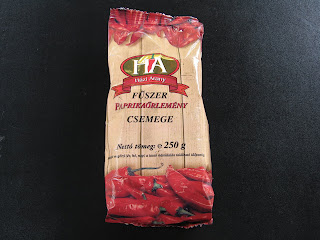
Hungarian paprika can be mild and sweet, semi-sweet and medium-hot or it can be very hot. The colour varies from bright red (milder) to a light red (the hottest). My favourite brand is Házi Arany (pictured below) which I get from a continental butcher in Oakleigh, Melbourne. I prefer the csemege which means 'exquisite delicate'. It has a sweet, slightly spicy flavour without being too hot. If you prefer a hotter variety and a spicier taste, go for the csemege csípős which translates as 'pungent exquisite delicate'. Erös is the hottest variety.


Hungarian Lesco

This recipe makes 4 generous servings, 15 minutes to prepare and about 25 minutes to cook.

Ingredients:
2 tablespoons oil
1 large onion
500g yellow banana peppers, cut into approximately 2cm squares
I large red capsicum, cut into approximately 2cm squares (optional but adds colour and texture)
2 large ripe tomatoes, (or 1/2 tin canned tomatoes) chopped
1 finely chopped red chilly (optional for hotheads)
1 csabai sausage cut into 1/2 cm slices
1 tablespoon sweet Hungarian paprika (read blurb above)
salt and freshly ground black pepper to taste.
crushed garlic (optional)

Use a large frying pan, saute the onion in the oil over low heat until it is caramelized, about 5 minutes and you'll get that lovely waft of the caramelized onion. Add the chopped tomatoes, banana peppers, red capsicum, (chilly if using), csabai sausage, paprika, (garlic if using), salt and ground black pepper and cook for another 15 minutes, stirring occasionally. Don't overcook the lesco or you will end up with a tomato sauce.

Sunday, February 1, 2009

Slow Cooked Ocean Trout with Wasabi Dressing


The temperature has been soaring in Melbourne in the last few days (up around the 44°C mark) hence the need for simple low temperature cooking. This is my adaption of Jacques Reymond's fabulous Slow Cooked Ocean Trout which I sampled at the Taste of Melbourne 2008. The addition of a simple wasabi egg yolk sauce transforms this fish into a gourmet meal.

Slow Cooked Ocean Trout with Wasabi Dressing

4 ocean trout fillets
1 tablespoon olive oil
1 Lebanese cucumber
Egg Yolk Dressing:
2 egg yolks
1 teaspoon wasabi paste (or to taste)
1 teaspoon sugar
freshly ground pepper
salt
300 ml fresh cream
verjuice (or dry vermouth)
Dill, coriander and broadleaf parsley for garnish.

Remove any bones from the fish with tweezers. Coat the bottom of the baking tray with the olive oil and add the fillets skin side down. Put the pan in to a cold oven then heat it to 120°C. The fillets will take 25 minutes to cook. Meanwhile, mix the egg yolks, wasabi, sugar, pepper and salt with some of the cream to get a smooth consistency. Add verjuice or vermouth to taste then add more cream until you reach the desired consistency. This will thicken as it stands. If the mixture curdles, beat in another egg yolk then add some more cream.

To serve, place some cucumber slices on the plates, then the cooked ocean trout fillets. Drizzle with the egg yolk dressing and scatter dill, coriander and parsley on top. Enjoy.


Sunday, January 25, 2009

Pear and Leek Soup


This is an elegant soup which I have adapted from a recipe by Beverley Sutherland Smith from her beautiful book 'A Taste of Class' (1980) which is now out of print. If you can find any of her books anywhere, grab them as she is a brilliant epicurean cook and author.

Note: It is important to use green pears as ripe pears will make the soup too sweet.

For the soup:

60g (2 oz) butter
1 bunch leeks (include a little of the green)
1 large potatoes, peeled and cubed
2 - 3 (500g) firm green pears
1 litre (4 cups) chicken stock
salt and ground pepper to taste

For garnish (optional):
Pouring cream and chopped fresh chives or fried leeks.

Slice leeks thinly into rings. In a large bowl of water, wash leeks and leave to drain well in a colander or sieve. In a heavy based saucepan, melt the butter. Saute the leeks until they are soft but don’t let them brown. Add the chopped pears and saute for a further few minutes. Add the potato cubes, cover with stock, season then simmer the soup gently until the potatoes are tender (approximately 30 minutes). Blitz soup until smooth and creamy.

To serve: Pour the cream gently over the back of a spoon to form a spiral pattern. Garnish with chives.

Baby Carrot Cakes


These lovely little morsels have been adapted from Loretta Satori’s Carrot Cake from 'The Cooks Book - Patisserie' (2004). 

Loretta Sartori is described as a pastry-chef extraordinaire, and has the reputation as being Melbourne’s best-kept culinary secret. She has given lessons at (Accoutrement) in Mosman and The Essential Ingredient in Melbourne.

Sartori's original recipe will make two 20cm round cakes. I have made 24 little cakes with the same quantity. The addition of the pineapple (preferably unsweetened) makes these little cakes very moist and although it is an oil based recipe, the cakes are lovely and light.

Baby Carrot Cakes

6 (300 g) medium eggs
400 g brown sugar
500 ml sunflower oil
450 g grated carrots
1 tin (350 g) crushed pineapple, well drained
180 g chopped walnuts
525 g all purpose flour
6 g bicarbonate of soda
10 g baking powder
6g cinnamon
4 g salt

Whisk the eggs and sugar until they are thick and pale. Using a slow speed on you mixer, carefully pour in the oil until it is absorbed. Stop the mixer and fold through the grated carrots, crushed pineapples and walnuts. Fold in the sieved dry ingredients. Spoon the mixture into the prepared cake tins. Bake at 175°C (350°F) for 20 to 25 minutes. If you prefer to make larger cakes, use 2 X 20 cm round cakes and bake for 35 to 45 minutes.

You can sprinkle castor sugar and cinnamon on top before they go in to the oven or leave them plain if they will be frosted later when cold.

Cream Cheese Frosting

500g cream cheese at room temperature
100g icing (confectioners) sugar
1 lemon, zest and juice
zest for decoration

Cream the cheese, icing sugar, lemon juice and zest until light and smooth. Spread over the tops of the little cakes. Sprinkle extra zest on top.